
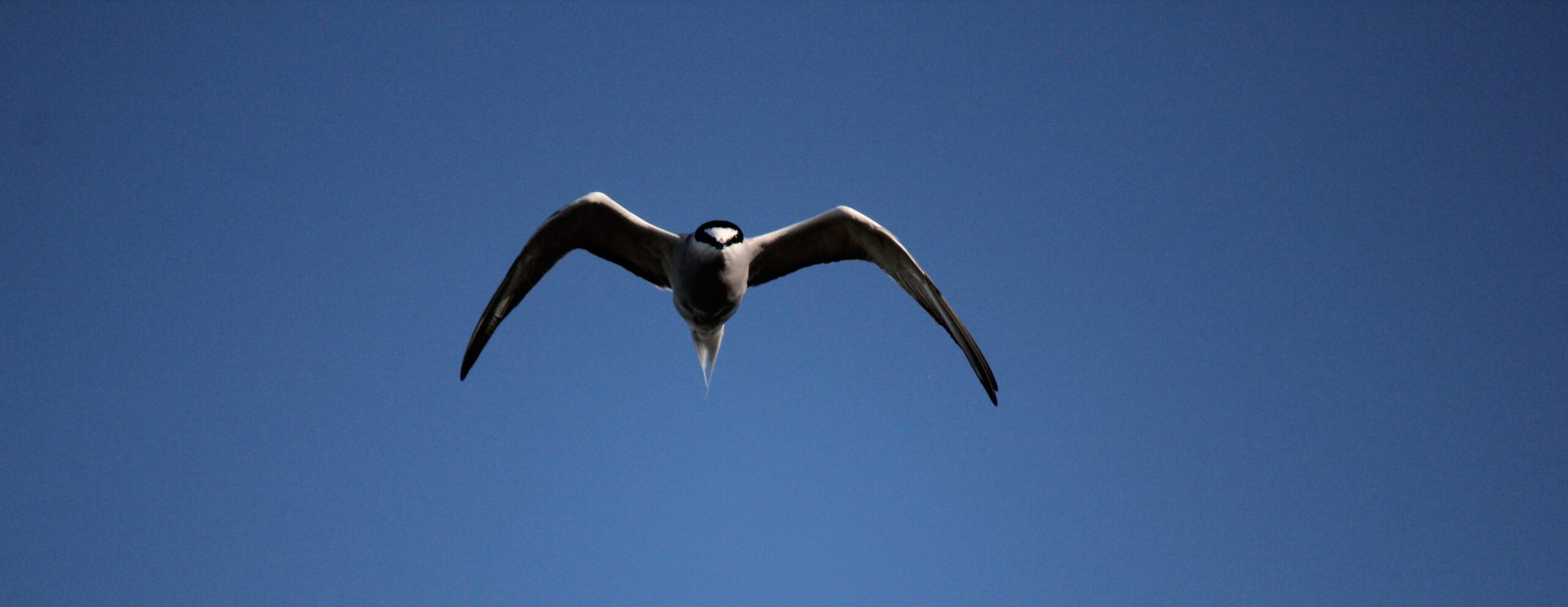
If you’ve ever watched terns hovering over an Alaska beach, there’s a chance you were looking at one of the state’s rarest seabirds. The U.S. Fish and Wildlife Service has been leading a big effort to find out how many Aleutian terns are left, and I wanted to share what they’ve learned so far, how to spot these birds, and how you can help.
How to tell an Aleutian tern from an Arctic tern
Terns in Alaska are pale gray seabirds with long, narrow wings, forked tails and black caps. You’ll usually see them hovering over the water and diving for small fish. Two species share the coast, and they can be hard to tell apart:
- Aleutian tern: black bill and legs, with a white forehead under the black cap. In flight, look for a dark trailing edge on the secondary feathers. They’re about 13 inches long, with a slender pointed bill, a deeply forked tail and a gray back.
- Arctic tern: red bill and legs. This is the much more common species, famous for one of the longest migrations of any bird.
- Listen, too: Aleutian terns have a soft, sweet, almost finch-like call. Arctic terns sound harsh and grating.
Aleutian terns breed only in Alaska and Russia, and they often nest close to Arctic tern colonies. After the nesting season, they head out along the Aleutian Island chain to the Yellow Sea, then travel south along the coasts of China and Southeast Asia to spend the winter in Indonesia and the Philippines.
Why biologists are concerned
Aleutian tern numbers in Alaska appear to have dropped steeply since the 1960s, while the Russian population may be holding steady. Because the decline is real but the data is thin, the species is listed as a Bird of Conservation Concern and as a Species of Greatest Conservation Need in Alaska. Internationally, the IUCN lists it as vulnerable.
One thing that makes them hard to track: colonies sometimes pick up and move after being disturbed, so an empty site doesn’t always mean the birds are gone.
A survey years in the making
- 2007: Seabird experts formed the Aleutian Tern Working Group.
- 2016: The group became the Aleutian Tern Technical Committee, bringing together federal and state agencies, universities and nonprofits.
- 2018 to 2019: The committee tested four ways of counting birds: ground counts of birds in flight, photos from the ground, low-altitude drone photos, and sound recordings paired with nest counts.
- 2020 to 2021: Methods were refined and a pilot survey ran during the breeding season.
- 2023: The three-year statewide survey kicked off. The U.S. Forest Service led Southeast Alaska, with the National Park Service helping in places like Glacier Bay National Park and Preserve.
- 2024 to 2025: FWS took the lead on the Kenai and Alaska Peninsulas, Bristol Bay, and Western and Northwest Alaska.
How the counting works
The survey happens in two steps. First, from June into July while the birds are sitting on eggs, small fixed-wing planes fly along the coast about 500 feet up, looking for colonies up to about 3.7 miles inland. Each plane carries a pilot and two or three observers.
Planes can find colonies, but they can’t reliably count birds or tell the two species apart. So ground crews follow up, getting to each colony by car, boat, plane or helicopter and then hiking in. At least two observers count the birds on their own, three times each, and confirm which species they’re seeing.
The 2024 and 2025 routes covered nine of Alaska’s 16 national wildlife refuges: Alaska Maritime, Alaska Peninsula, Becharof, Izembek, Kenai, Kodiak, Selawik, Togiak and Yukon Delta.
How you can help
- Watch for nests near beaches. Terns like flat, grassy spots above the high tide line, and their nests are often just shallow scrapes with well-camouflaged eggs. Hovering or alarm-calling terns usually mean a nest or chicks are close.
- Stay out of nesting areas and respect any signs or fencing. Even one disturbance can cost a pair its eggs or chicks, and repeated disturbance can make a whole colony leave.
- Watching and photographing terns is fine. Just keep your distance, stay put and avoid flushing the birds.
- Keep dogs on a leash near colonies.
- Cut down on plastic and toss fishing line and other trash in covered bins so birds don’t get tangled.
- Report colonies or changes you notice to ak_mbm@fws.gov and/or ak_fisheries@fws.gov with a subject like “Aleutian tern sighting.” Replies may be slow during field season.
- Join a local bird count, help look after your local beach, and spread the word.
Who’s involved
The survey is a team effort between FWS, the U.S. Forest Service, the National Park Service, the Prince William Sound Science Center, Oregon State University and the Audubon Seabird Institute, McDonald Data Sciences and Tern Again Consulting.
Read more on the U.S. Fish and Wildlife Service website: Aleutian Tern Surveys
Source: U.S. Fish and Wildlife Service. Featured photo: U.S. Fish and Wildlife Service